Question 16
$\begin{align} & \text{Evaluate }3(x+2)>6(x+3) \\ & (A)\text{ }x>4\text{ }(B)\text{ }x<4\text{ }(C)\text{ }x>-4\text{ }(D)\text{ }x<-4 \\\end{align}$

$\begin{align} & \text{Evaluate }3(x+2)>6(x+3) \\ & (A)\text{ }x>4\text{ }(B)\text{ }x<4\text{ }(C)\text{ }x>-4\text{ }(D)\text{ }x<-4 \\\end{align}$
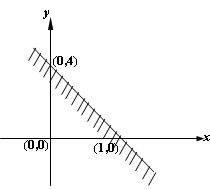 The shaded region above is represented by the equation.
Find the range of values of m which satisfy $(m-3)(m-4)<0$
The value of y for which $\frac{1}{5}y+\frac{1}{5}<\frac{1}{2}y+\frac{2}{5}$is
Solve the inequality ${{x}^{2}}+2x>15$
Solve the inequality $-6(x+3)\le 4(x-2)$
Solve the inequalities $-6\le 4-2x<5-x$
For what range of values of x is $\tfrac{1}{2}x+\tfrac{1}{4}>\tfrac{1}{3}x+\tfrac{1}{2}$
Find the range of value for which $3x-7\le 0$ and $x+5>0$
Determine the value of x for which $({{x}^{2}}-1)>0$