Question 20
The sum to infinity of a geometric progression is $-\tfrac{1}{10}$and the first term is $-\tfrac{1}{8}$.Find the common ratio of the progression.

The sum to infinity of a geometric progression is $-\tfrac{1}{10}$and the first term is $-\tfrac{1}{8}$.Find the common ratio of the progression.
The nth term of a sequence ${{n}^{2}}-6n-4$. Find the sum of the 3rd and 4th terms.
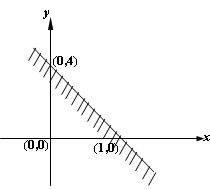 The shaded region above is represented by the equation.
Find the range of values of m which satisfy $(m-3)(m-4)<0$
The value of y for which $\frac{1}{5}y+\frac{1}{5}<\frac{1}{2}y+\frac{2}{5}$is
U is inversely proportional to the cube of V and U = 81 when V = 2. Find U when V=3
If y varies directly as $\sqrt{n}$and y =4 when n =4, find y when $n=1\tfrac{7}{9}$
Solve for x and yin the equation below$\begin{align} & {{x}^{2}}-{{y}^{2}}=4 \\ & x+y=2 \\\end{align}$
Find the remainder when $2{{x}^{3}}-11x+8x-1$is divided by x + 3
Make n the subject of the formula if $w=\frac{v(2+cn)}{1-cn}$